
The Brothers Karamazov
Based on the Novel by: Fyodor Dostoevsky
Translator: Ahad Aligholian


Project Description
The Brothers Karamazov is not a single performance, but a developing, ongoing theatrical project. It has evolved over seven years of continuous group rehearsal, during which the ensemble navigated challenges such as the COVID-19 pandemic, the Women, Life, Freedom movement, and the Iran-Israel conflict. These experiences enriched the novel’s dramaturgy and allowed the performers’ collective life, alongside the text, to become the main narrators of the performance.
Audiences encounter a seven-hour event with no division between onstage and offstage. Non-narrative elements—including the temporal structure, the performers’ embodied presence, and media—create a multi-layered, unpredictable experience. Spectators become active participants and co-creators, transforming the performance into a “theatrical situation,” where the work is no longer mere “theatrical imagination” but emancipatory.
The Brothers Karamazov represents a search for new modes of perception, the re-presentation of the novel, and theatre-making in Iran.
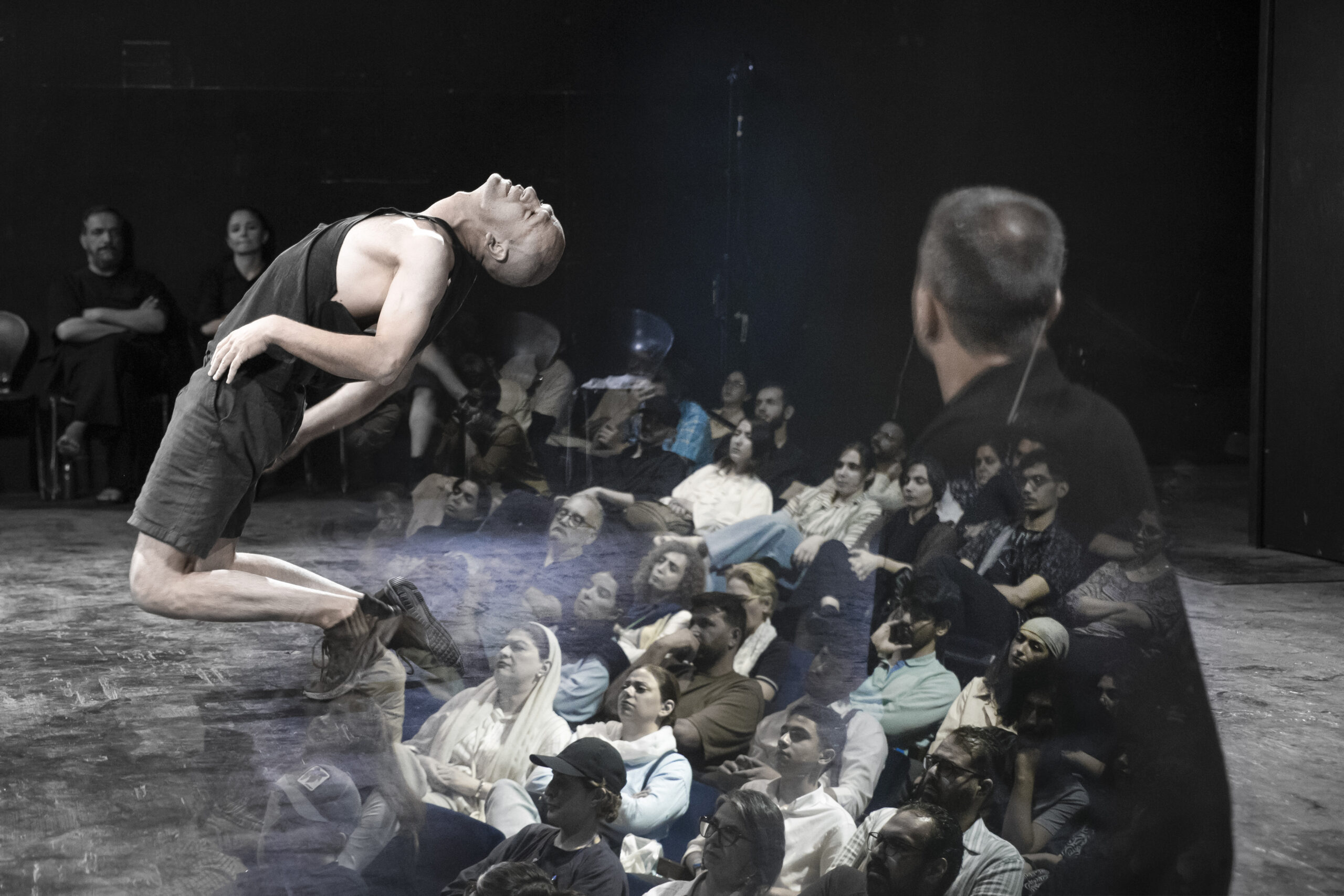


Ivan Karamazov’s Essay: In Pursuit of My Mother’s Photographs...
Collective Note
Can Theatre Practice Democracy?
For us, theatre is not a representation of democracy—it is a field in which democracy can be lived and practiced. Here, democracy is not a fixed ideology but an unstable, collective process, always open to negotiation. Members of a group do not occupy hierarchical positions; each brings their own desires, sensitivities, and conflict. From the early rehearsals, our aim has been to translate these democratic principles into action, allowing each participant’s aesthetic experience to be preserved and developed throughout the project.
This approach has produced a living collage of 38 interwoven parts—drawing on dance, improvisation, song, and media. In each part, the performers act as dramaturgs, using personal choreography, bodily strategies, and presence to imbue the work with distinct character and identity. Some parts emerge entirely without the intervention of directors or dramaturgs. The performance remains alive: rehearsals continue throughout the week, and every Saturday, as the show unfolds on stage, new parts are added, keeping the collective experience evolving, never fixed, and constantly renewed.
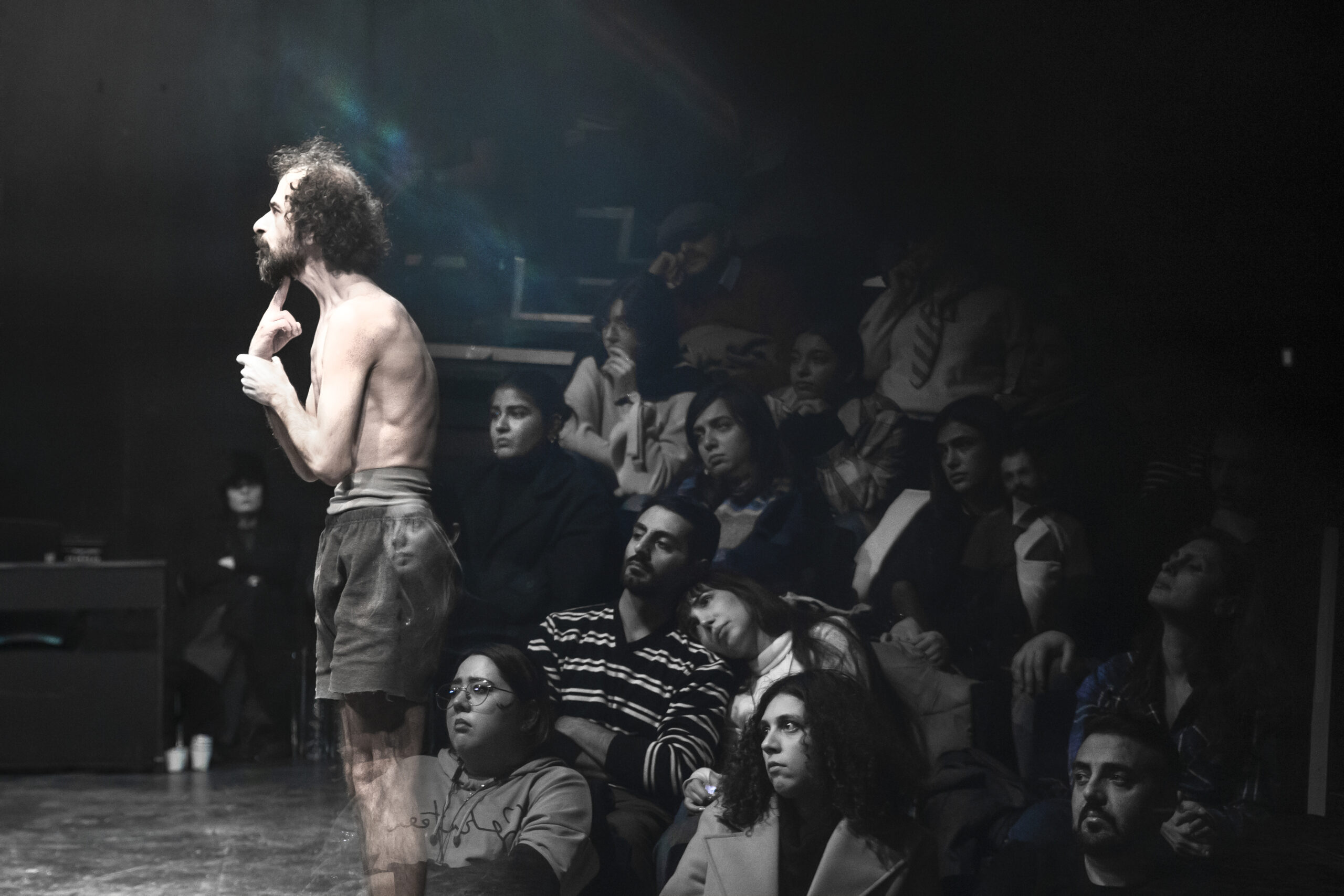


The Audience’s Gaze
Venues & Dates
- Iranshahr Theatre, Samandarian Hall, Tehran, Iran – From November 2024 (Ongoing)
A Collective Work by
We believe that each role is, at its core, a collection of “tasks.” In this project, roles are not assigned by title, but emerge through the work that is performed. Seen this way, distinctions between prompter, writer, stage manager, or director dissolve, because in this performance, a role is born from the blending of concepts often treated as fixed—character, performer, actor, group member, artist—and each participant, through their engagement, shapes something entirely new.
Names are listed without hierarchy: Majid Aghakarimi, Vahid Ajorlou, Mehdi Hesam Alzakerin, Erfan Amin, Mehrdad Babaei, Fares Bagheri, Shekiba Bahramian, Sahar Rajabi, Mostafa Qaheri, Tahere Hezave, Sajad Hamidian, Ashkan Kheilnejad, Amin Manian, Aynaz Mousaei, Atena Naderzadeh, Maryam Nourmohammadi, Keyhan Parchami, Mohammadreza Rashidi, Hamed Rasouli, Milad Shajareh, Mehdi Shahedi, Hosseyn Tabatabaei, Sina Barzegar, Mojtaba Karimi, Yousef Bapiri, Mohammad Farzaneh, Ahad Aligholian, Avazeh Javaherian, Reza Abedini, Anooshiravan Aria, Alireza Esmaeilpour, Niayesh Solgi, Mehrdad Rezaie, Morteza Abdolmaleki, Mehran Ashki, Shayan Taghdisi, Mahla Ahmadi, Babak Ahmadi, Amir Ghanbari, Amir Hemmati, and Amir Masoud Vaez Tehrani.
Duration
7 Hours
Schedule: Saturdays, 15:00–22:00, with two intermissions