
Whose Life is it Anyway?

Project Description
The play Whose Life Is It Anyway? was revived by Peter Hall in 2005, after originally winning the Society of West End Theatre Award in 1978 and earning a Tony Award nomination following its Broadway debut in 1997. The play was translated into Persian in 2007; however, the production faced legal challenges in Iran due to religious and social sensitivities surrounding the subject of voluntary death.
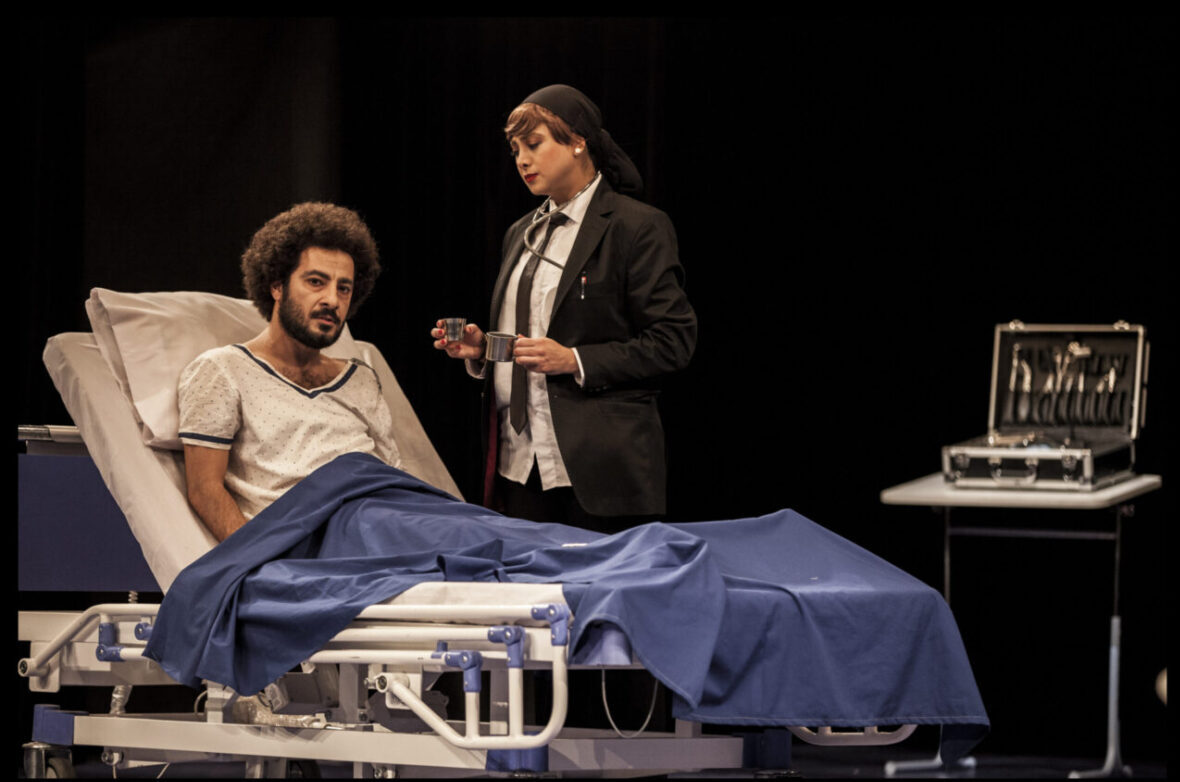
The story follows Ken Harrison, a paralyzed sculptor, who fights for his right to die with dignity. His struggle raises profound questions about free will, human dignity, and who truly controls life and death. Ken’s sharp wit stands in stark contrast to the ethical dilemmas faced by Dr. Emerson and his medical team, inviting the audience to reconsider the limits and moral responsibilities of human action.

Director’s Note
How can theatre’s aesthetic form challenge ethical issues?
This question guided our performance at Molavi Theatre (black box). We created a theatrical experience with a panoramic, simultaneous stage design, allowing the audience to frame the action from multiple angles and consider ethical questions from different perspectives. As the production moved to Nazarezadeh Hall (auditorium), we asked: “How do performers’ bodies shape a space? How can movement challenge its power structures?”
Rooted in movement design, the performance shifted from a panoramic to a panoptic space. The hospital set, stripped of doors and walls, allowed characters to move freely, highlighting the tension between freedom and control. The patient’s stillness contrasted with surrounding movement, raising the question: “How can stillness become an act of resistance under constant observation?” Ken Harrison’s immobility asserted his bodily autonomy, while active characters, paradoxically, appeared constrained by their own actions.
Through this progression, we invited the audience to reflect on both the aesthetic and the ethical dimensions of control, power, and resistance.
Awards
- Best Directing and Best Actor from the 14th Iran International University Theatre Festival (IIUTF) – 2011
Venues & Dates
- Molavi Theatre, Ground Hall, Tehran, Iran – June and July 2011
- Iranshahr Theatre, Nazarezadeh Hall, Tehran, Iran – November and December 2014
- Fadjr International Theatre Festival (FITF), Tehran, Iran – Featured in the 33rd International Category – February 2015
Creative Team
- Director: Ashkan Kheilnejad
- Playwright: Brian Robert Clark
- Translator: Ahmad Kasaeipour
- Set Designers: Saeid Hassanlou / Ashkan Kheilnejad (in the second run)
- Costume Designer: Alma Goshtasb / Maryam Nourmohammadi (in the second run)
- Lighting Designer: Reza Heydari
- Composers: Kaveh Abedin / Mohammad Tabbakhian (in the second run)
- Make-up Designers: Hasti Ghayour / Mohammad Gholami (in the second run)
- Make-up Artists: Siavash Goudarzi and Parisa Nemati Moghadam
- Poster, Brochure, and Teaser Designers: Arman Kouchaki, Mehdi Davaei, and Makan Kouchaki (PLAY+PAUSE STUDIO)
- Photographers: Mehdi Ashna, Noushin Jafari , and Kamran Chizari
- Media Advisor: Samin Mohajerani (in the second run)
- Assistant Director and Programmer: Hosseyn Iraji
- Stage Managers: Behzad Es-haghi, Morteza Akbarinejad / Davood Vandadeh, Ghasem Ghazanfari, Mostafa Latifikhah, and Behzad Haji Hasani (in the second run)
Cast
- Navid Mohammadzadeh
- Mohammad Hadi Ataei
- Neda Golrangi
- Elahe Shahparast
- Masoumeh Rahmani / Azadeh Samadi (in the second run)
- Houman Kiaei
- Negin Khamesi / Mina Karimi Jebeli (in the second run)
- Keyvan Saketof
- Faranak Kalantar / Hamid Rahimi (in the second run)
- Arnavaz Safari / Shahabeddin Hosseinpour (in the second run)
- Rouzbeh Hesari / Sina Balahang (in the second run)
- Mohammad Ashkanfar
Duration
110 Minutes
Impact
- Performances: 60
- Audience: ~ 9,000

Production
- Producer: Tazeh Theatre Group